
Descriptive Trademarks and the “Pizza Puff” Lesson
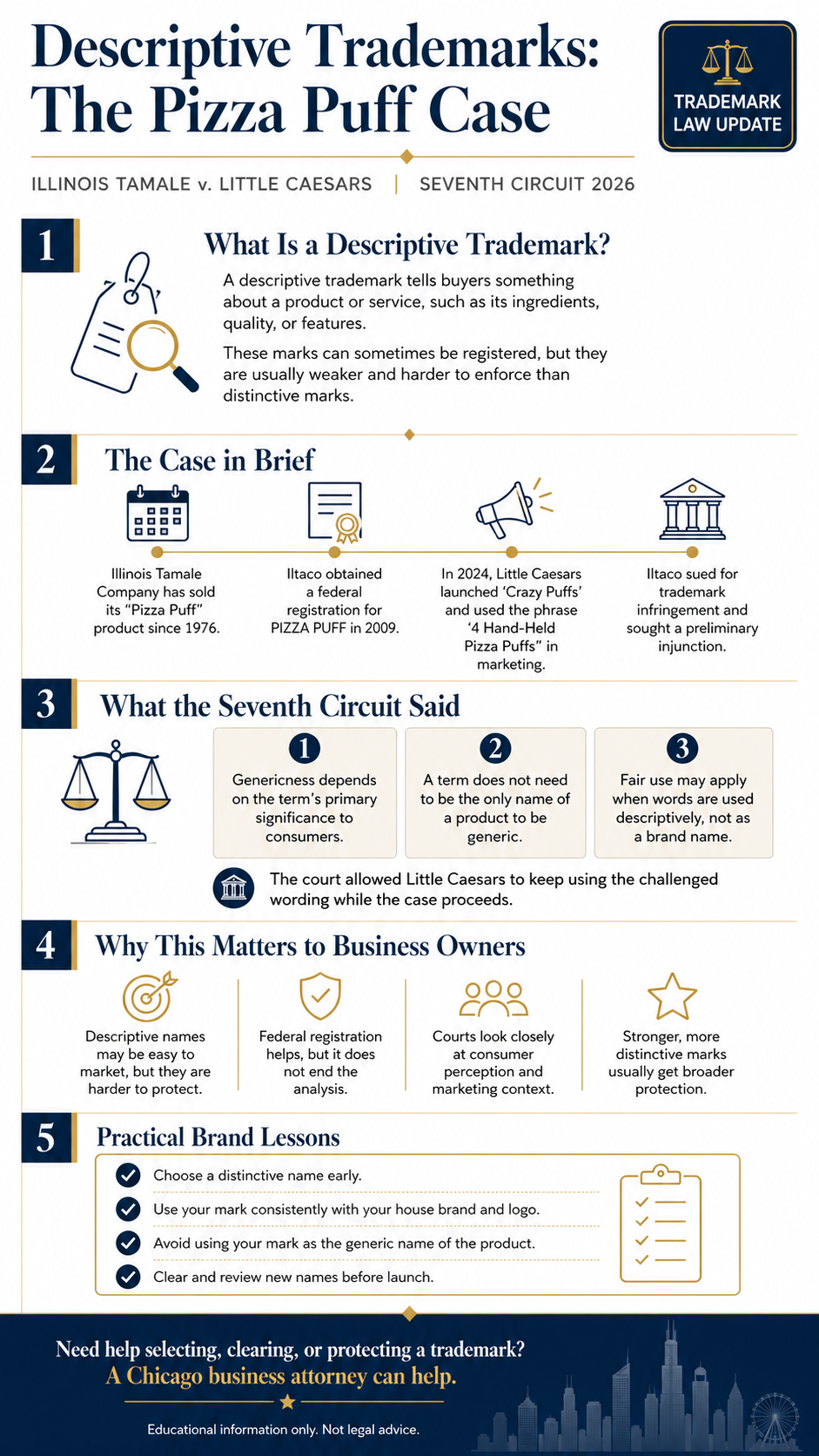 When entrepreneurs choose a trademark for a brand, there’s a common temptation to pick something that instantly tells customers what the product is. The legal problem is that the more a name “describes” the product, the harder it becomes to protect—and the easier it is for competitors to use similar wording without infringing. That’s the heart of the Illinois Seventh Circuit’s January 2026 decision in Illinois Tamale Company, Inc. (Iltaco) v. LC Trademarks, Inc. and Little Caesar Enterprises, Inc., a case that offers a practical roadmap for understanding descriptive trademarks and why “descriptive” can be a double-edged sword.
Below is a brief overview of the trademark dispute and what it teaches business owners about selecting, registering, and enforcing descriptive trademarks.
What Are Descriptive Trademarks?
Trademarks generally fall on a spectrum of distinctiveness. At one end are generic terms (the common name of the product), which cannot function as trademarks. Moving up the spectrum are descriptive terms, which describe an ingredient, characteristic, quality, purpose, or feature of the product. Descriptive trademarks can be protectable, but they’re often weaker because they overlap with language competitors may legitimately need to describe their own goods.
At the stronger end are suggestive, arbitrary, and fanciful trademarks—names that don’t directly describe the product. Those trademarks typically receive broader protection because they are more clearly “brand identifiers” rather than “product descriptions.”
So where do descriptive trademarks create risk? Two big places: (1) a competitor may argue the term is actually generic (or has become generic over time), and (2) even if the trademark is valid, a competitor may raise “fair use” by showing it used the term descriptively rather than as a brand name.
The “Pizza Puff” Trademark Dispute: What Happened
Illinois Tamale Company (doing business as Iltaco) is a Chicago-based food company founded in 1927. It began selling its “pizza puff” product in 1976—described as similar to a calzone, but made with a flour tortilla wrapped around pizza toppings and then fried or baked.
Iltaco registered “Pizza Puff” as a federal trademark in 2009 and later obtained a registration for “Puff” in 2022.
In March 2024, Little Caesars launched “Crazy Puffs,” a baked pizza-dough product (small cups filled with pizza ingredients and topped with cheese). Little Caesars marketed the product heavily using its well-known brand elements (its trade name, signature orange branding, and its “Crazy” family of marks). In its advertising, Little Caesars also used the phrase “4 Hand-Held Pizza Puffs” in smaller print beneath “Crazy Puffs.”
Iltaco sent a cease-and-desist letter and then sued in the Northern District of Illinois, asserting federal trademark infringement and related claims. Iltaco asked the court for a preliminary injunction to stop Little Caesars from using “Crazy Puffs,” “Pizza Puff,” and “Puff” in connection with the product.
After an evidentiary hearing, the district court granted an injunction as to “Pizza Puff,” but denied it as to “Crazy Puffs” and “Puff.” On appeal, the Seventh Circuit reversed the “Pizza Puff” injunction and affirmed the rest—meaning Little Caesars could continue using the challenged language while the case proceeded.
Why the Decision Matters for Descriptive Trademarks
The court’s opinion is especially helpful because it illustrates two concepts that business owners run into all the time:
A registered trademark—even one with strong “registration status”—can still be attacked as generic if consumers primarily understand it as a product category name, not a brand.
A competitor can sometimes use trademarked words in a descriptive way (classic fair use), particularly when the words describe product features rather than serving as the competitor’s brand.
Both points are central to understanding descriptive trademarks in the real world.
Lesson 1: Genericness Turns on “Primary Significance,” Not “Exclusive Descriptor”
A major portion of the Seventh Circuit’s analysis focused on whether “Pizza Puff” was likely generic. The court emphasized the proper legal test: whether the primary significance of the term to consumers is the product category (generic) or a brand identifier.
The court also clarified that a term does not need to be the “exclusive” way to describe a product to be generic. In other words, the fact that competitors could use other words is not the point; a product can have multiple generic names, and any one of them may be incapable of trademark significance if consumers primarily treat it as the category name.
From a business perspective, this is a crucial reminder: if your “brand name” is also a common product descriptor, you may eventually face a genericness challenge—especially as competitors, reviewers, and even customers adopt the term as shorthand for a type of product.
The Evidence the Court Highlighted
At the preliminary-injunction stage, Little Caesars introduced evidence aimed at showing that consumers mainly perceive “pizza puff” as a common term rather than a brand. The opinion discusses consumer-perception evidence, including survey evidence (a “Teflon” format survey) and other marketplace materials courts often consider when evaluating genericness.
For entrepreneurs, the practical takeaway is not that surveys are required in every trademark dispute, but that consumer perception can decide the fate of descriptive trademarks. If the public uses your trademark as the name of the thing (not the name of your thing), protection gets harder.
Lesson 2: Descriptive Use and Fair Use Can Defeat an Injunction
Even if a trademark is valid, a trademark owner seeking to stop a competitor typically must show a likelihood of success on the merits. In this case, the Seventh Circuit emphasized that Iltaco also had to contend with Little Caesars’ “fair use” defense.
The Lanham Act’s classic fair use defense generally applies when a defendant shows: (1) it did not use the phrase as a trademark (meaning not as a brand), (2) the use is descriptive of its goods, and (3) it used the phrase fairly and in good faith.
The key point for descriptive trademarks: “descriptive” means “describing features,” not “naming the product”
The district court rejected fair use on the theory that “pizza puffs” was not descriptive of Little Caesars’ product because the product didn’t obviously look like “a puff.” The Seventh Circuit said that approach was too narrow. The term does not have to be a perfect “product identity label” to be descriptive; it can be descriptive if it refers to a characteristic of the goods.
The opinion points to evidence that Little Caesars’ product could reasonably be described as “puffy” and “airy,” and that it contained pizza ingredients. From that, the court concluded the phrase could function descriptively in context.
Context Matters: How the Words Were Presented
Another practical factor was how Little Caesars used the words. The record described “Pizza Puffs” appearing in small print as part of “4 Hand-Held Pizza Puffs,” directly under the “Crazy Puffs” branding and alongside Little Caesars’ prominent trade name and distinctive trade dress.
That kind of presentation tends to support the argument that the phrase is being used to describe the product rather than to brand it. For business owners, this is a real-world reminder that infringement is not decided only by comparing words in the abstract; courts look hard at the full marketing context.
What Entrepreneurs Should Take From the Case
1) If you want strong protection, don’t start with a descriptive name
If the focus is long-term brand value, descriptive trademarks are often the hardest path. A name that instantly tells customers what the product is may be easy to market in the short term, but it can be harder to defend when a larger competitor uses similar language to describe its product.
This doesn’t mean descriptive trademarks are useless. It means you should plan for the reality that enforcement can be more difficult and more expensive.
2) If you must use a descriptive term, build “brand meaning” early
Businesses can sometimes protect descriptive trademarks by building strong consumer association between the term and the company (what lawyers call “secondary meaning”). In practical terms, that means consistent branding, consistent presentation, and marketing that trains customers to see the term as the brand—not the category.
One simple example: instead of emphasizing the descriptive term alone (“PIZZA PUFF”), pair it consistently with a distinctive house mark and logo. Over time, consumers may begin to associate the combined presentation with a single source.
3) Watch for generic “slippage” in your own marketing
A common brand mistake is using the trademark as a noun (the thing) instead of as an adjective (the brand of the thing). If customers start using the trademark as the name of a category, and the advertising reinforces that behavior, it increases the risk of genericness arguments later. The court’s focus on consumer perception underscores how quickly that issue can become central.
4) Understand what a competitor can do even if you have a registration
Many business owners believe a federal trademark registration ends the discussion. It does not. This case involved registered trademarks, yet the Seventh Circuit still treated genericness and fair use as serious merits issues at the injunction stage.
5) If you’re enforcing a descriptive trademark, be prepared to prove consumer perception
When enforcement matters—especially in fast-moving situations where you want a preliminary injunction—you should expect the other side to challenge protectability and raise fair use. The stronger your evidence of consumer association, the more leverage you have.
A Practical Checklist for Choosing a Protectable Mark
If you’re naming a new product, service, or company in Illinois, here are a few attorney-style “gut checks” that help avoid the descriptive trademark trap:
Bottom Line
The “Pizza Puff” decision is an excellent teaching case for entrepreneurs because it shows how descriptive trademarks live on a fault line: they can be registrable and valuable, but they are often vulnerable to genericness arguments and fair-use defenses—especially when a competitor uses the words in a clearly descriptive way alongside strong house branding.
If you’re selecting a brand name, the safest long-term move is to pick something distinctive from day one. If you’re already using a descriptive name, the next best move is to strengthen the brand around it and document the consumer association you’ve built—so you’re not trying to prove it for the first time in litigation.