
Understanding 13 du Pont Factors: Likelihood of Confusion
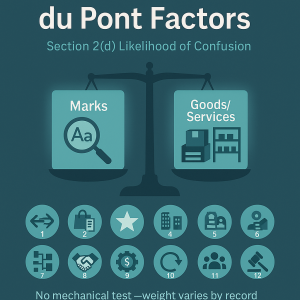 Section 2(d) (Likelihood of Confusion) of the Lanham Act bars registration when an applied‑for trademark is likely to cause confusion, mistake, or deception as to the source or sponsorship of the goods or services. In other words, the question isn’t simply “Will people mix up the trademarks?” but “Will people think the goods or services come from the same company—or that there is an affiliation or sponsorship—because of the trademarks used?” That is the heart of the USPTO’s likelihood‑of‑confusion analysis.
The du Pont Factors: How the USPTO Weighs Likelihood of Confusion Under Section 2(d)
To answer that question, the USPTO and the courts apply the thirteen du Pont factors from In re E. I. du Pont de Nemours & Co. There is no mechanical test; each case turns on its evidence, and different factors may matter more in different records. That said, two factors almost always get outsized weight: (1) similarity of the marks and (2) relatedness of the goods/services. The rest help confirm or temper what those two suggest.
The 13 du Pont factors—Plain English and Practical Notes
Below we walk through each of the 13 likelihood of confusion factors with brief guidance on how it’s commonly proved, what it tends to show, and where applicants or brand owners often stumble. Not every factor will be relevant in every case, and the weight of each factor can vary.
1) Similarity of the marks in appearance, sound, connotation, and commercial impression
This factor considers the trademarks as a whole. Word trademarks are evaluated in ordinary presentations (standard‑character law), while designs and stylization matter for composite or design trademarks. Similarity in any of the four dimensions—look, sound, meaning, or overall impression—can tip this factor. In practice, identical or highly similar dominant elements usually carry the day, especially for ordinary consumer goods.
Practice tip: Focus on the words actually in the applied‑for and cited trademarks. Trade dress can illuminate commercial impression, but it cannot replace what the words convey. If your theory depends on packaging or imagery, document real‑world exposure and consistency over time.
2) Similarity/relatedness of the goods or services
The USPTO compares the identifications in the application/registration, not just how the parties happen to market today. Broad wording (“soft drinks”) can overlap a narrower identification (“citrus‑flavored soft drinks”), which leads to presumptions that channels of trade and purchasers also overlap. The more closely related the goods/services, the less similarity between marks is required to find likely confusion.
Practice tip: Draft or amend identifications with litigation in mind. Tailoring identifications may narrow overlap and meaningfully shift the analysis.
3) Similarity of established, likely‑to‑continue trade channels
If goods/services are legally identical in part, overlapping trade channels are often presumed. Otherwise, the record should show where and how the goods/services move (retail shelves, ecommerce marketplaces, professional channels). Evidence includes third‑party retailer pages, distributor listings, and industry practices.
Practice tip: If you need this factor to cut against confusion, develop proof of distinct channels (e.g., specialty B2B distributors vs. mass retail) and explain why movement into the other’s trade channel is unlikely.
4) Conditions of sale and buyer sophistication
Impulse, low‑cost purchases increase the risk of confusion; high‑dollar, careful purchasing can reduce it. The relevant buyer is the ordinary purchaser of the identified goods/services.
Practice tip: Price points, purchase process, and buyer expertise should be supported with credible evidence (price listings, industry reports), not assumption.
5) Fame/strength of the prior mark
A stronger (more famous) trademark casts a longer shadow. Strength can be conceptual (inherent distinctiveness) and commercial (marketplace recognition). Famous marks enjoy a wider scope of protection, requiring less similarity to find confusion.
Practice tip: For strength, bring current, product‑specific metrics: sales, market share, distribution, advertising spend, press, awards, and awareness surveys. Avoid over‑claiming fame beyond the relevant goods/services.
6) Number and nature of similar marks in use on similar goods/services
Crowded fields narrow the scope of protection. Extensive third‑party use/registration of similar terms for similar goods can show consumers are used to small differences.
Practice tip: Prioritize use evidence (screenshots, catalog pages) over registrations alone. Tie the uses to real marketplace exposure.
7) Evidence of actual confusion
Actual confusion is powerful but rare. The absence of reports usually carries limited weight, particularly for fast‑moving consumer goods, unless the record shows meaningful opportunity for confusion to have occurred (overlapping geography, time, and volume).
Practice tip: Keep complaint‑tracking logs and retailer feedback organized. If you rely on “no actual confusion,” explain why meaningful opportunities existed.
8) Length of concurrent use without actual confusion
Long, overlapping use without confusion can help, but only with evidence of substantial marketplace overlap. Short or limited coexistence has little probative value.
Practice tip: Provide dates, volumes, and channels showing real contact in the marketplace—not just parallel existence online.
9) Variety of goods on which the prior mark is used
House trademarks or family marks used widely may be entitled to broader protection across product lines. Conversely, a narrowly used trademark may have a tighter scope.
Practice tip: Document the range of goods/services and connect them to consumer recognition of the trademark as a unifying source.
10) Market interface between the applicant and the owner of a prior mark
Think consent agreements, coexistence agreements, licenses, settlement agreements history. A well‑crafted consent agreement can be highly persuasive, especially when it includes concrete steps to avoid confusion (distinct packaging, channels, geographic limits, fields of use, complaint‑exchange provisions).
Practice tip: Avoid bare‑bones “naked consents.” Explain why confusion is unlikely and what each party will do to keep it that way.
11) Applicant’s right to exclude others from use of its mark
Prior registrations, successful enforcement history, or statutory rights can show that the applicant has carved out distinct source significance for its trademark.
Practice tip: Point to adjudicated rights or incontestable registrations when available, and connect them to the same or closely related goods/services.
12) Extent of potential confusion
This factor recognizes that even limited confusion can be significant for certain goods/services or channels. The analysis is qualitative: how serious and widespread would the likely confusion be?
Practice tip: Explain the real‑world consequences of a mistaken belief in common source or sponsorship (e.g., safety issues, reputational harm, misdirected customer service).
13) Any other established fact probative of the effect of use
This is the catch‑all that lets the decision‑maker weigh unusual circumstances. One example is long‑term coexistence of substantially similar trademarks owned by the same applicant for identical goods, which can outweigh a strong confusion showing. But the details matter: the trademarks must be the same or not meaningfully different, the goods/services must match in relevant part, and the coexistence should be substantial.
Practice tip: Use this factor for genuinely atypical facts (e.g., incontestable prior registration owned by the applicant for the same goods) and be prepared to distinguish cases where the trademarks or goods were meaningfully different or coexistence was short.
The “Big Two” Usually Drive the Result
Although any factor can control a case, the USPTO and the Federal Circuit repeatedly emphasize that similarity of the trademarks and relatedness of the goods/services are the core considerations in most records. When goods/services are identical or legally overlapping, the law presumes shared channels and ordinary purchasers, and less similarity between the trademarks is needed to find confusion. Conversely, when goods/services are far apart and channels, buyers, and conditions of sale diverge, even similar marks can sometimes coexist without confusion.
Building a Winning Record (for Applicants and Opposers)
Contact Our Law Firm For Trademark Assistance
We evaluate every new brand against the du Pont framework from day one. In clearance, we focus on the “big two” and the practical presumption about channels and purchasers. In prosecution, we tailor identifications and build records that reflect what consumers actually see. In trademark disputes, we assemble market‑tested evidence—third‑party use, consent agreements, purchaser context, and strength metrics—to either sharpen or defuse the likelihood‑of‑confusion showing.
If you’re clearing a new mark, facing a §2(d) likelihood of confusion refusal, or weighing an trademark opposition strategy, our trademark attorneys can help you navigate the du Pont factors and position your brand for protection.
Before you print labels or launch a website, have our trademark attorneys run a full trademark search. A trademark search and clearance goes far beyond a quick USPTO lookup—it screens for look-alikes, sound-alikes, translations, misspellings, and conceptually similar terms across the goods and services you’ll actually offer. We examine federal and state registries, business names, domains and social handles. That evidence lets us pressure-test the two big du Pont factors—how close your proposed trademark is to earlier trademarks and how related the goods/services are—so you can avoid surprises. Even if you plan only intrastate use, earlier federal, state or common law rights can still block you, force a rename, or box you into a narrow territory; once you expand into interstate commerce, the risks multiply (think: §2(d) refusal, demand letters, packaging write-offs, new domains, SEO losses, and goodwill erosion). A thorough trademark search also informs strategy: proceed as-is, adjust the name, tailor the identification of goods/services, pursue a consent agreement, or file an intent-to-use application to lock in priority while you finalize branding.