
Valuation Methods When Buying or Selling a Business
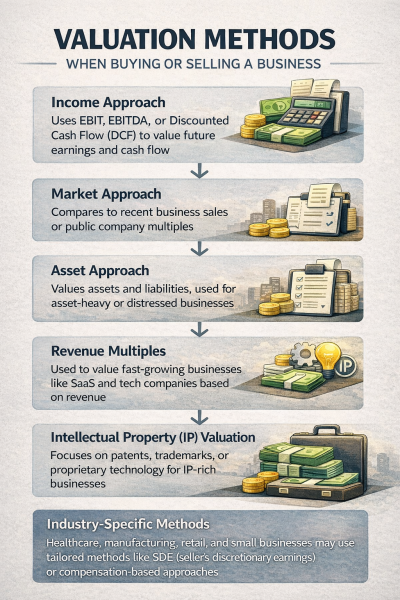 When a business is bought or sold, the price rarely comes from a single “magic” number. Buyers and sellers often start with a familiar metric—like revenue, EBIT, or EBITDA—then layer in industry expectations, risk, growth potential, and deal terms to arrive at a value that feels defensible. That is why valuation discussions can feel confusing: two sophisticated parties can look at the same company and reasonably arrive at different prices using different methods.
The good news is that most deal pricing follows a recognizable set of valuation approaches. If you understand the major methods and when they’re typically used, you can predict how buyers will frame your value, where negotiations are likely to tighten, and what you can do to improve your outcome. This article walks through the most common valuation methods used in business purchase and sale transactions, explains how they show up in different industries, and highlights special considerations for startups, small businesses, and businesses with significant intellectual property like patents and trademarks.
Why there are multiple valuation methods
Valuation is ultimately an exercise in predicting future economic benefit and deciding how much to pay for it today. Because businesses generate economic benefit in different ways, no single method works perfectly across all industries. A capital-intensive manufacturing company may look “worse” under an EBITDA multiple if its true cash needs are high, while a subscription software business may look “better” under revenue multiples because its future margins are expected to expand dramatically. A fast-growing startup may not have meaningful profits at all, requiring investors to value it based on traction, growth, and comparable deals.
In practice, buyers often use multiple methods at once. One method provides an anchor, another provides a sanity check, and a third helps them negotiate risk. Sellers who understand these frameworks tend to negotiate from a position of strength because they can speak the buyer’s language and anticipate the due diligence questions behind the numbers.
The Income Approach: Valuing Earnings and Cash Flow
The income approach values a business based on the profits or cash flow it is expected to generate. In many private company transactions, this is the most influential set of tools because buyers are ultimately paying for the business’s ability to produce returns.
One common method is the multiple of earnings approach, often framed around EBIT or EBITDA. EBIT (earnings before interest and taxes) focuses on operating profitability without the effects of financing and taxes, while EBITDA adds back depreciation and amortization to approximate operating cash flow before capital expenditures and working capital changes. In deal discussions, you will frequently hear buyers quote EBITDA multiples, especially in the middle market, because EBITDA is widely used for comparing companies and estimating debt capacity. But that doesn’t mean EBIT is irrelevant. For asset-heavy businesses, buyers may start with EBITDA and then adjust for maintenance capital expenditures, essentially moving the analysis closer to EBIT in economic terms.
A simple hypothetical shows why metric choice matters. Imagine two companies with identical EBITDA of $2 million. Company A is a consulting firm that requires minimal capital expenditures. Company B is a transportation company that must regularly replace vehicles. A buyer may assign a higher multiple to Company A because more of that EBITDA is truly distributable. Company B’s “real” free cash flow may be much lower, even if EBITDA is the same, so a buyer may pay a lower multiple or insist on adjustments tied to fleet reinvestment.
A second income method is discounted cash flow (DCF), which models the business’s expected future cash flows and discounts them back to present value. DCF is conceptually elegant and can be very persuasive for businesses with predictable cash flows, but it is also sensitive to assumptions—growth rates, margins, reinvestment needs, and discount rates. In a sale negotiation, DCF is often used as a supporting analysis rather than the only pricing method, because small changes in assumptions can swing value significantly. Still, DCF becomes more important when the buyer is sophisticated, the company is larger, or the business has long-term contracts that make forecasting more reliable.
The income approach also includes capitalization methods (sometimes used by appraisers for stable businesses), where a single period of normalized earnings is divided by a “capitalization rate” that reflects risk and growth. This is essentially a simplified DCF that assumes stable, long-term performance. It’s common in valuation reports for established small businesses with steady earnings and modest growth.
The Market Approach: Comparing Your Business to Others
The market approach values a business by reference to pricing observed in comparable transactions or public company multiples, adjusted for differences in size, growth, customer concentration, margins, and risk.
In practice, this shows up in two ways. The first is guideline public company multiples, where analysts examine public companies in the same or adjacent industries and apply those multiples to a private company with adjustments for scale and liquidity. The second, and often more relevant for private deals, is precedent transactions—pricing paid in recent acquisitions of similar companies. When a business broker tells a seller, “Companies like yours are selling for 3–5x EBITDA,” that is essentially a market approach statement, even if it’s based on broker experience rather than a formal dataset.
Market approach pricing tends to dominate when the industry has a strong “rule of thumb” and transaction volume is high. For example, many business services, HVAC, landscaping, and certain healthcare practices often trade within recognizable ranges. The buyer still performs diligence, but the initial pricing framework often comes from comparable multiples observed in the market.
A helpful reality check is that the market approach is not just about your current numbers. It’s about the story buyers believe. If comparable deals are pricing at higher multiples for businesses with recurring revenue, diversified customers, and documented processes, then those qualities become value drivers in negotiations—even if they don’t immediately change EBIT or EBITDA. Sellers can often increase their multiple, not just their earnings, by reducing perceived risk.
The Asset Approach: Valuing What the Business Owns
The asset approach values a business based on the fair market value of its assets minus its liabilities. This method is common when the business’s value comes more from its underlying assets than its earnings power, or when earnings are inconsistent.
Asset-based valuation is frequently used for holding companies, real estate-heavy businesses, or distressed businesses. It may also appear in negotiations where the buyer is effectively purchasing equipment, inventory, or a book of contracts rather than a going concern with stable profits.
However, sellers should be careful with asset-based framing if the business has strong earning power. Many profitable operating companies are worth far more as going concerns than the liquidation value of their assets. If a buyer pushes heavily toward asset-based valuation for an operating business with meaningful cash flow, it may be a negotiation tactic to lower the price or limit downside risk.
Revenue Multiples and Other “Top-Line” Methods
For some businesses—especially those growing fast—buyers and investors may use revenue multiples rather than profit multiples. This is common when profits are intentionally suppressed by growth investment, or when the buyer expects margins to improve post-acquisition.
Software and SaaS are the classic examples. A subscription software company may be valued on a multiple of annual recurring revenue (ARR), sometimes with adjustments for retention, churn, growth rate, and gross margin. A high-growth SaaS company with strong retention might command a far higher revenue multiple than a services business with the same revenue, because the predictability and scalability are different.
Revenue methods can also appear in certain agencies, ecommerce brands, and healthcare services—though the multiples and logic vary. The key is that revenue multiples are rarely “just revenue.” Buyers implicitly assume a path to margins, so they will ask questions that test whether revenue quality is strong: concentration, retention, pricing power, customer acquisition efficiency, and unit economics.
Which Valuation Methods are Typically Used by Industry
Industries develop valuation norms because buyers in those spaces face similar economics and risks. While exceptions are common, there are patterns.
Manufacturing, distribution, transportation, and other capital-intensive businesses often start with EBITDA multiples but quickly move into EBIT-like thinking through capex adjustments. Inventory levels, working capital swings, and equipment replacement cycles heavily influence how much of “earnings” is truly available to a buyer.
Professional services firms often use EBITDA or EBIT multiples, but valuation can hinge on owner dependence and client concentration. Buyers may also use compensation-based normalization, asking what it costs to replace the owner’s role and then valuing profits after that adjustment.
Healthcare practices can involve a mix of EBITDA multiples, “collections” multiples, or provider compensation models depending on specialty and payer mix. Many buyers focus on durability of cash flow, compliance risk, and the ability to recruit or retain providers.
Software and tech-enabled services frequently lean on revenue multiples, ARR multiples, and growth-adjusted metrics. Even when EBITDA is considered, buyers often focus on gross margin, retention, and scalability, because those metrics predict future profitability.
Retail and restaurants often trade on a combination of seller’s discretionary earnings (SDE), EBITDA, and asset considerations, with location quality, lease terms, and operational systems playing outsized roles.
Valuation Methods Typically Used for Startups
Startups often cannot be valued using traditional earnings methods because profits may be negative and the business model may still be developing. As a result, startup valuation tends to rely on market and growth-based methods.
Venture investors commonly use comparable financings, comparable company multiples (often revenue-based), and “venture capital method” thinking—estimating a plausible future exit value and backing into today’s price based on required returns and dilution. Metrics like user growth, ARR growth, customer acquisition cost, lifetime value, retention, and gross margin may carry more weight than EBIT.
A hypothetical illustrates the dynamic. A startup with $1 million ARR might be losing money because it is investing aggressively in sales. An investor may still value it at a multiple of ARR if retention is strong and growth is accelerating. But if churn is high and acquisition costs are rising, that same ARR could command a much lower valuation. For startups, the “method” is often less important than the quality of underlying traction.
Valuation Methods Typically Used for Small Businesses
Small business transactions often revolve around seller’s discretionary earnings (SDE), especially when the buyer is an owner-operator. SDE is typically the profit available to a working owner after adding back discretionary expenses and non-recurring items, and it often includes the owner’s compensation. This matters because the buyer may be stepping into the owner’s role rather than hiring a management team.
Small businesses also tend to be valued with simpler multiples and heavier emphasis on practical risk: customer concentration, owner dependence, financial records quality, lease terms, and the stability of demand. A buyer may not run a full DCF, but they will still evaluate whether the cash flow is real, sustainable, and transferable.
If a small business reports $250,000 in SDE but the owner is the lead salesperson and the only person who knows how to deliver the service, a buyer may discount the multiple because the business is not easily transferable. If the same business has documented processes, trained staff, and recurring contracts, buyers may be willing to pay more even if SDE is identical.
Valuation Methods for Businesses with Significant IP – Patents, and Trademarks
Businesses with meaningful intellectual property often require additional valuation lenses because IP can be both an asset and a driver of future earnings. Traditional earnings multiples still matter, but buyers may also consider the strength, defensibility, and monetization potential of the IP portfolio.
One common approach is still income-based: valuing the business’s expected cash flows that are attributable to the IP—especially if the IP supports premium pricing, licensing income, or durable market share. Another approach is relief-from-royalty, an IP valuation method that estimates what the company would have to pay in royalties if it did not own the IP and instead licensed it. This method is often used for trademarks and patented technology in formal valuation contexts, and it can be especially relevant when IP licensing is part of the business model.
Cost-based IP valuation sometimes appears as well, particularly when the IP is early-stage and not yet producing measurable earnings. The logic is that the cost to recreate the IP (development costs, time, engineering) provides a baseline. But cost is not the same as value, and sophisticated buyers typically focus on commercial impact: does the IP prevent competition, enable higher margins, reduce customer churn, or open new markets?
For sellers, the key is to present IP not as a list of registrations but as a business advantage. A trademark portfolio that supports a premium brand, reduces customer acquisition costs, and protects market position can increase the multiple. Patents that block competitors or create licensing opportunities can change the buyer universe entirely. But buyers will diligence IP aggressively, including chain of title, enforceability, remaining patent term, freedom-to-operate risks, and whether the business truly depends on the IP or merely owns it.
Other Insights That May Help Buyers and Sellers in Real Deals
Whatever valuation method is used, value is heavily influenced by “quality of earnings.” Buyers want to know whether earnings are repeatable and transferable. That’s why normalization matters: removing one-time events, adjusting owner compensation to market, and separating personal expenses from business operations. Sellers who prepare a clean, well-supported earnings picture often reduce buyer skepticism and create competitive tension that improves price and terms.
Deal structure also affects effective value. An offer with a higher headline price but a large earnout, seller note, or contingent payments may be riskier than a lower all-cash offer. Buyers use structure to bridge valuation gaps when they disagree about future performance. Sellers should evaluate not just the multiple, but the certainty and timing of proceeds.
Working capital is another frequent surprise. Many deals include a working capital “peg” that requires the seller to deliver a normal level of working capital at closing. If the seller has reduced inventory or delayed payables to boost short-term cash flow, the buyer may require a post-closing adjustment that effectively reduces purchase price. Understanding how your working capital behaves can prevent unpleasant last-minute renegotiations.
Finally, the best valuation method in the world cannot compensate for weak preparation. A business with clean financial statements, documented processes, diversified customers, and a management team that can operate without the owner will usually command better multiples and smoother closing outcomes—regardless of whether the buyer starts with EBIT, EBITDA, revenue, or SDE.