
When Amazon Questions Your Trademark Lawyer
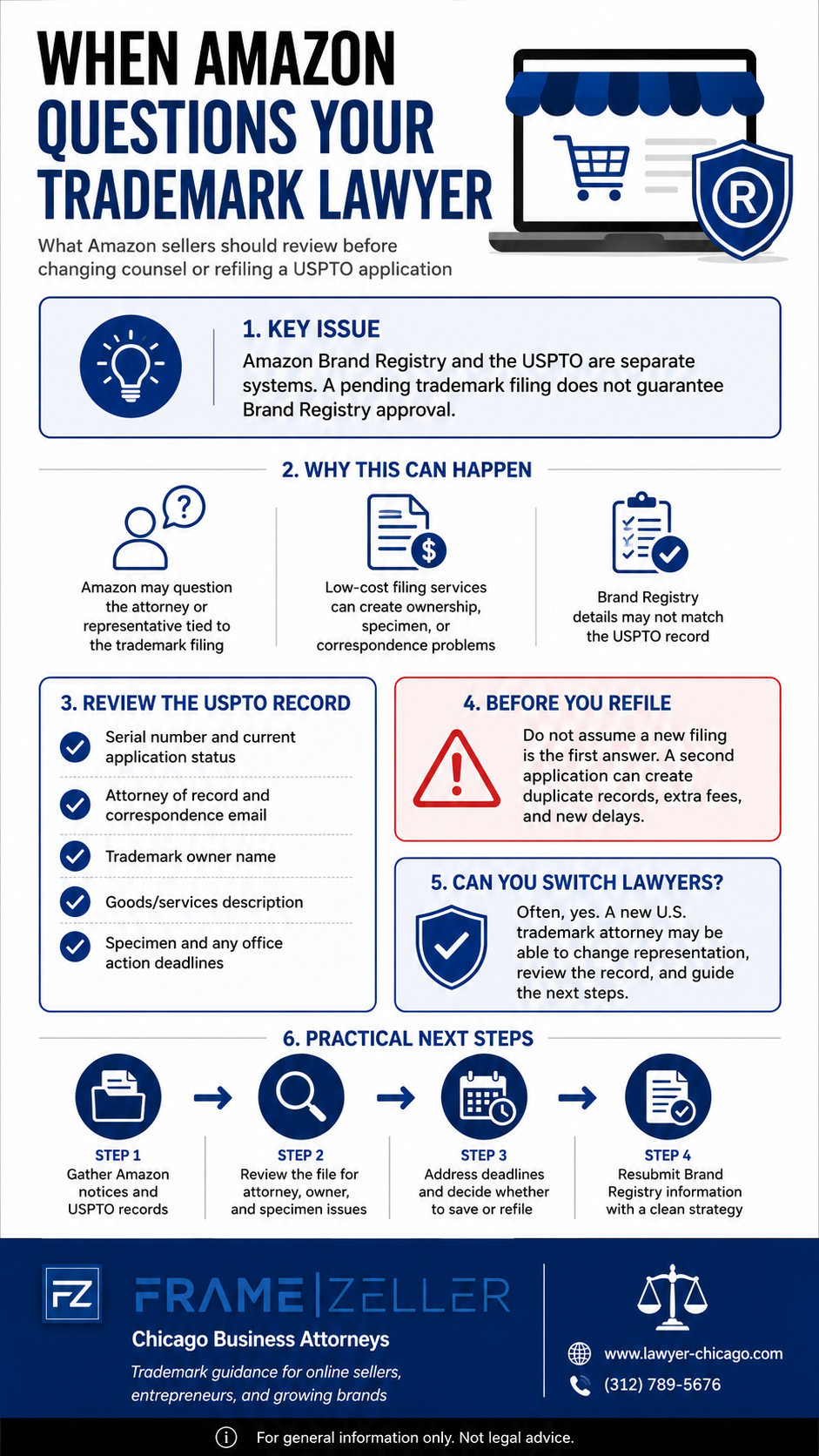 For an Amazon seller, few messages are more frustrating than learning that Brand Registry has been rejected or delayed because of a problem with the trademark attorney tied to the USPTO trademark application.
The seller’s first reaction is usually confusion. The trademark application was filed. A USPTO serial number exists. The filing receipt looks official. Maybe the seller paid a company that promised a quick path into Amazon Brand Registry. Then, suddenly, Amazon says there is an issue with the attorney of record, the representative, or the trademark filing information.
That is a bad moment, especially for a small business owner who is trying to launch products, clean up listings, stop copycats, or protect a brand that is finally getting traction. The good news is that this problem does not always mean the trademark application is worthless. It also does not always mean the seller has to start over. But it does mean the seller should slow down, get the USPTO record reviewed, and avoid making a second rushed mistake.
The Problem May Not Be the Brand Name
When Amazon flags or questions the attorney connected to a trademark application, many sellers assume the brand name itself has been rejected. Sometimes that is not true.
Amazon Brand Registry and the United States Patent and Trademark Office serve different roles. The USPTO examines whether a trademark qualifies for federal registration. Amazon decides whether a seller meets Amazon’s platform rules for Brand Registry. Those two systems overlap, but they are not the same.
A trademark application may be alive and pending at the USPTO while Amazon still refuses Brand Registry enrollment. Amazon may be concerned about the attorney listed in the USPTO record, the owner name, the product images, the brand name shown on packaging, or whether the information provided to Amazon matches the trademark application. The USPTO may later examine the same trademark application for entirely different issues, such as likelihood of confusion, descriptiveness, specimen problems, or inaccurate goods and services.
In plain English, Amazon may be saying, “We are not comfortable using this trademark filing for Brand Registry,” while the USPTO may not have made any final decision at all.
That distinction matters because the fix depends on the actual problem.
Why Amazon Cares About the Attorney
Amazon Brand Registry gives brand owners tools that can affect listings, infringement complaints, product detail pages, and enforcement activity on the marketplace. Amazon has a practical interest in making sure that the trademark filings used to gain Brand Registry access are legitimate and controlled by the real brand owner.
That is why the attorney of record can become important. If Amazon sees that the trademark application was filed by an attorney, service provider, or filing operation that Amazon does not accept for Brand Registry purposes, it may refuse to move forward even if the USPTO trademark application still appears active.
Not every flagged-attorney situation means the seller did something wrong. Sometimes the business owner hired the wrong service without knowing it. Sometimes the seller thought they were hiring a U.S. trademark lawyer but mostly dealt with a website portal, a sales representative, or a chat-based filing company. Sometimes the seller never received a real trademark search and clearance opinion, never spoke with the attorney listed in the USPTO record, and never understood who would receive USPTO correspondence.
This is where cheap trademark filing can become expensive. A bargain filing may look fine at the start because the seller receives a serial number. The problem appears later, when Amazon reviews the record or when the USPTO issues an Office Action.
Start by Taking Control of the File
The first practical question is simple: who controls the trademark file?
A seller should know the USPTO serial number, the owner listed in the application, the attorney of record, the correspondence email, the filing basis, the goods or services listed, and the current status of the application. If the seller does not know these things, that is not unusual, but it is a warning sign.
The correspondence email is especially important. USPTO notices, including Office Actions and deadlines, are sent to the correspondence contact in the trademark record. If that email belongs to a prior attorney, a filing service, or someone the seller can no longer reach, the seller may miss critical notices. In some situations, the seller may also have difficulty completing Amazon’s verification process if communications go to someone else.
A new trademark lawyer can usually begin by reviewing the USPTO record, checking the prosecution history, and determining whether the applicant can appoint new counsel or revoke prior representation. That step sounds administrative, but it can be the difference between regaining control and letting the application drift toward abandonment.
Do Not Rush Into a New Trademark Filing
Many sellers respond to an Amazon rejection by saying, “Let’s just file another trademark.” That might eventually be the right answer, but it should not be the first move.
A second trademark application can create duplicate filings, additional filing fees, inconsistent ownership records, and confusion about which trademark application Amazon should rely on. It can also restart the timeline. For sellers who were hoping to use a pending application for Brand Registry, losing weeks or months may be a real business problem.
There are situations where a new trademark application makes sense. For example, if the original trademark application was filed in the wrong owner’s name and cannot be corrected, if the specimen was improper, or if the goods and services are badly mismatched, starting fresh may be cleaner. But that conclusion should come after reviewing the file, not before.
A rushed refile can turn a fixable issue into a bigger mess.
What a Trademark Attorney Should Review
When a seller brings us a Brand Registry rejection tied to an attorney issue, the attorney name is only one part of the review. The larger question is whether the trademark application is worth saving.
The owner name is often the first place to look. The owner should generally be the person or business entity that actually owns the trademark. If an LLC sells the product, owns the brand assets, pays for inventory, and operates the Amazon account, but the trademark was filed in the founder’s individual name, that mismatch needs to be evaluated. Sometimes an ownership issue can be corrected. Sometimes it cannot.
The trademark itself also needs attention. Amazon usually expects the brand name in the Brand Registry submission to match the trademark record. If the trademark application is for a logo but the seller is trying to enroll a slightly different word brand, Amazon may object. If the seller uses punctuation, spacing, or wording differently on packaging than in the application, that can cause unnecessary delays.
The goods and services matter too. A seller of pet grooming brushes should not have a vague or inaccurate identification that fails to describe the actual products. The description does not need to sound fancy. It needs to be accurate.
Then there is the specimen. This is one of the most common places where low-cost filings fail. For goods, the USPTO typically wants to see the trademark used as a trademark on the product, packaging, label, tag, or a proper point-of-sale display. A digitally created mockup, a decorative phrase printed across the product, or a screenshot that does not show a real purchasing context may create problems.
Finally, the lawyer should check for Office Actions. Amazon’s rejection may feel urgent, but a USPTO deadline can be unforgiving. If an Office Action is pending, the seller may have only a limited window to respond or request an extension where available. Missing that deadline can lead to abandonment.
A Tale of Two Amazon Sellers
Consider two examples.
The first seller owns a small fitness accessories brand called GripForge. The owner hired a low-cost online service that advertised Amazon Brand Registry help. The service filed a trademark application in the owner’s personal name, even though the business operates through an LLC. The specimen was a mockup of packaging that had not actually been used in commerce. The goods description was broad and clumsy. Amazon then rejected the Brand Registry application because it questioned the attorney tied to the filing.
For GripForge, changing lawyers may be necessary, but it may not be enough. A new attorney would need to review ownership, use, specimen evidence, goods, deadlines, and whether the application can be corrected. If the trademark application has too many defects, a new trademark filing may be the better long-term strategy.
Now take a different seller. A home organization company called ShelfPilot hired an attorney who filed the application correctly. The LLC is the owner. The goods are accurate. The product packaging shows the trademark clearly. There is no pending Office Action. Amazon later questions the attorney of record because of an issue unrelated to that seller’s brand.
For ShelfPilot, the solution may be much more straightforward. A new U.S. trademark attorney may be able to step in, update representation, review the file for any hidden issues, and help the seller resubmit Brand Registry materials with cleaner documentation.
Both sellers received a similar Amazon problem. Legally, their files are very different.
Watch Out for the “Guaranteed Approval” Pitch
A seller dealing with a Brand Registry delay is vulnerable. Inventory may already be purchased. Listings may be live. Competitors may be copying images or product descriptions. It is tempting to hire the first person who promises a quick fix.
Be careful with anyone who guarantees Amazon approval, refuses to identify the attorney actually handling the matter, communicates only through messaging apps, or says the USPTO record does not matter. Also be cautious if someone recommends filing a new trademark application immediately without reviewing the existing application.
A legitimate trademark lawyer should be able to explain the status of the USPTO file, the risks, the next step, and the limits of what can be promised. No attorney can control Amazon’s internal review process. But a careful attorney can help clean up the trademark side, address pending USPTO issues, and put the seller in a stronger position.
What Sellers Should Do Next
If Amazon has rejected or delayed Brand Registry because of the trademark lawyer or attorney of record, gather the key documents before making another move. Save the Amazon rejection notice, the USPTO serial number, the filing receipt, any Office Actions, emails from the prior filing company, product photos, packaging photos, and proof of who owns the brand.
Then have the trademark file reviewed. The review should answer practical questions. Is the application still alive? Who owns it? Who receives USPTO correspondence? Can new counsel appear? Is there a pending deadline? Is the specimen acceptable? Do the goods match the products sold on Amazon? Does the Brand Registry submission match the USPTO record?
Sometimes the answer is to change representation and continue with the existing application. Sometimes the seller also needs to respond to an Office Action or correct information in the record. In other cases, the seller may be better off filing a new application with clean ownership, accurate goods, and proper evidence of trademark use.
The Bottom Line
An Amazon Brand Registry rejection tied to a trademark lawyer is frustrating, but it is not always a dead end. The important thing is to avoid guessing. Amazon’s message may point to an attorney issue, but the trademark application itself may have additional problems that need attention.
For Amazon sellers, the trademark filing is more than a ticket into Brand Registry. It is part of the legal foundation for the brand. It can affect enforcement, licensing, expansion, and the ability to stop competitors from using confusingly similar names.
If Amazon has questioned the attorney connected to your trademark application, the next step is not panic. The next step is control: control of the USPTO record, control of correspondence, control of deadlines, and control of the legal strategy moving forward.
Our Chicago trademark attorneys assist entrepreneurs, online sellers, and small businesses with trademark searches, USPTO applications, attorney changes, Office Action responses, and Brand Registry-related trademark issues. If your filing needs to be reviewed or your prior attorney needs to be replaced, getting a clear legal assessment early can save time, money, and unnecessary re-filing.